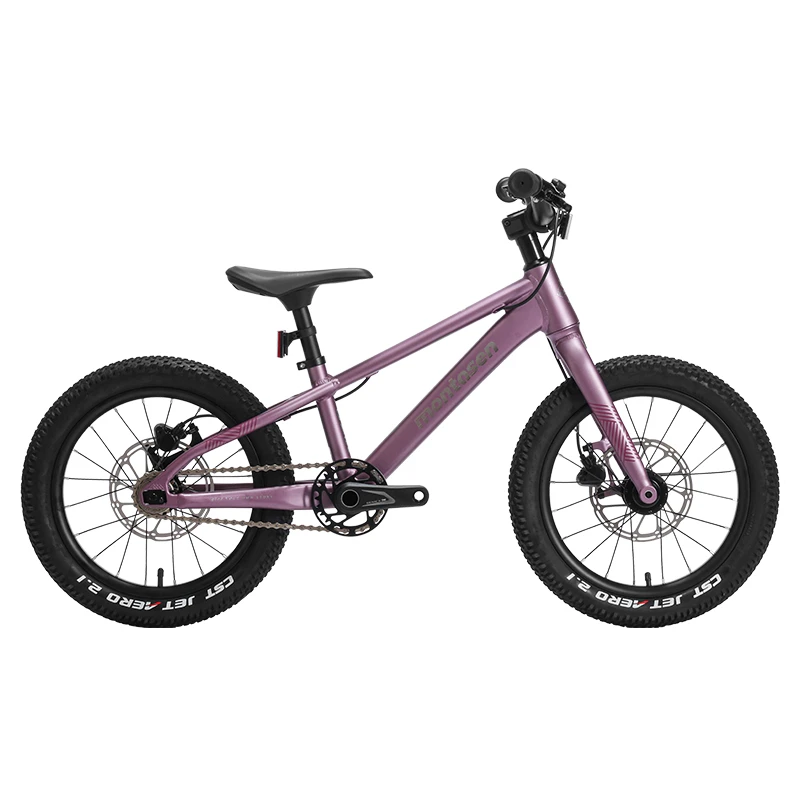
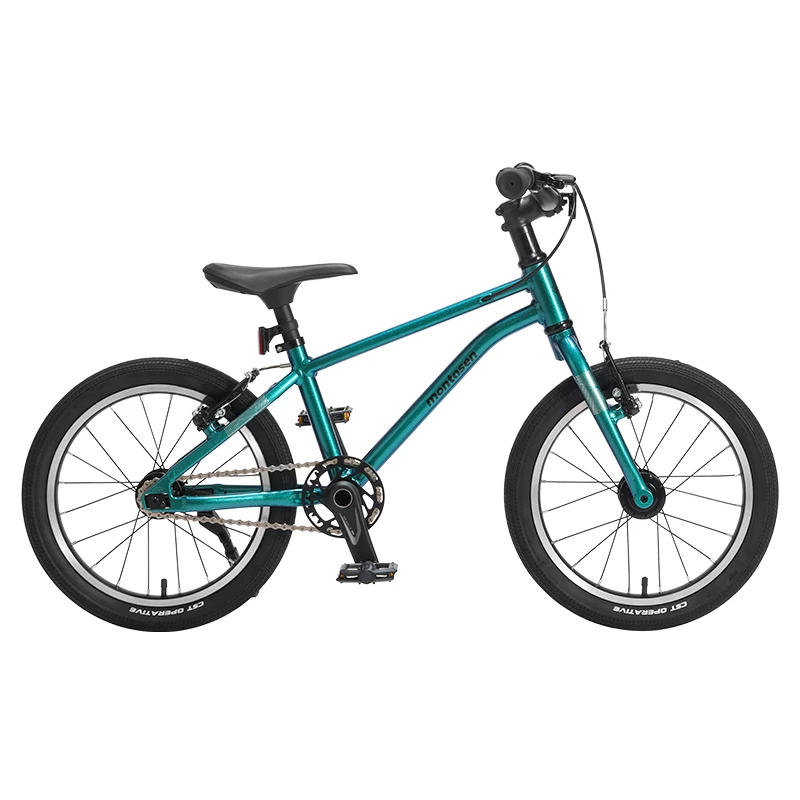
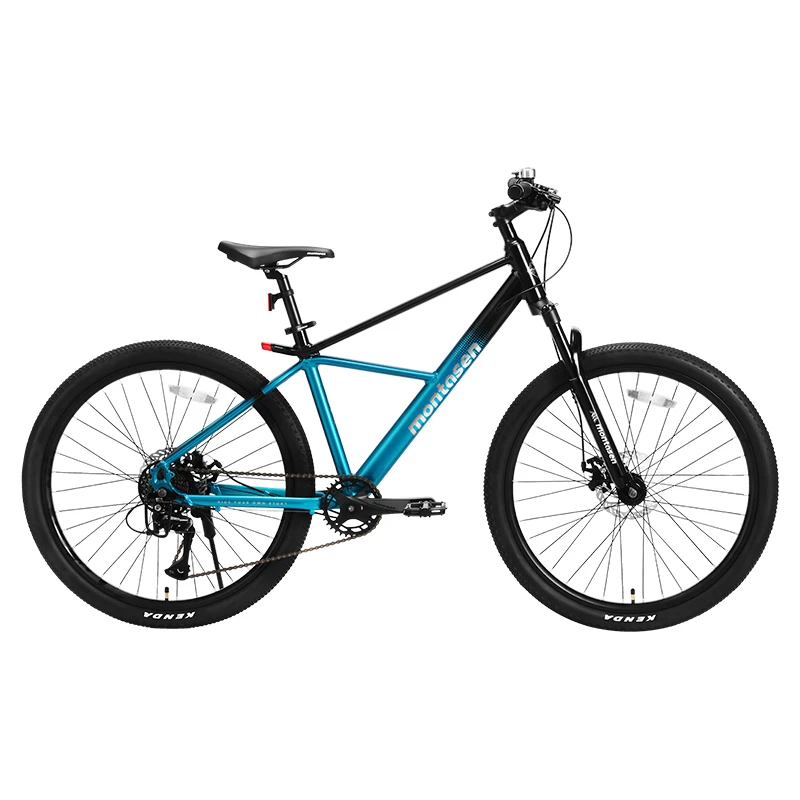
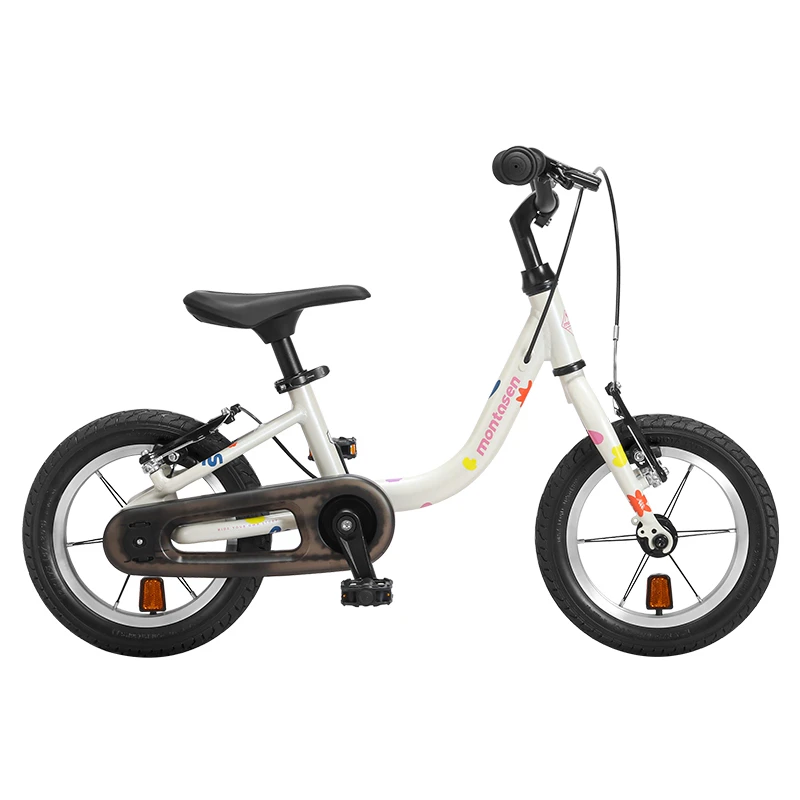
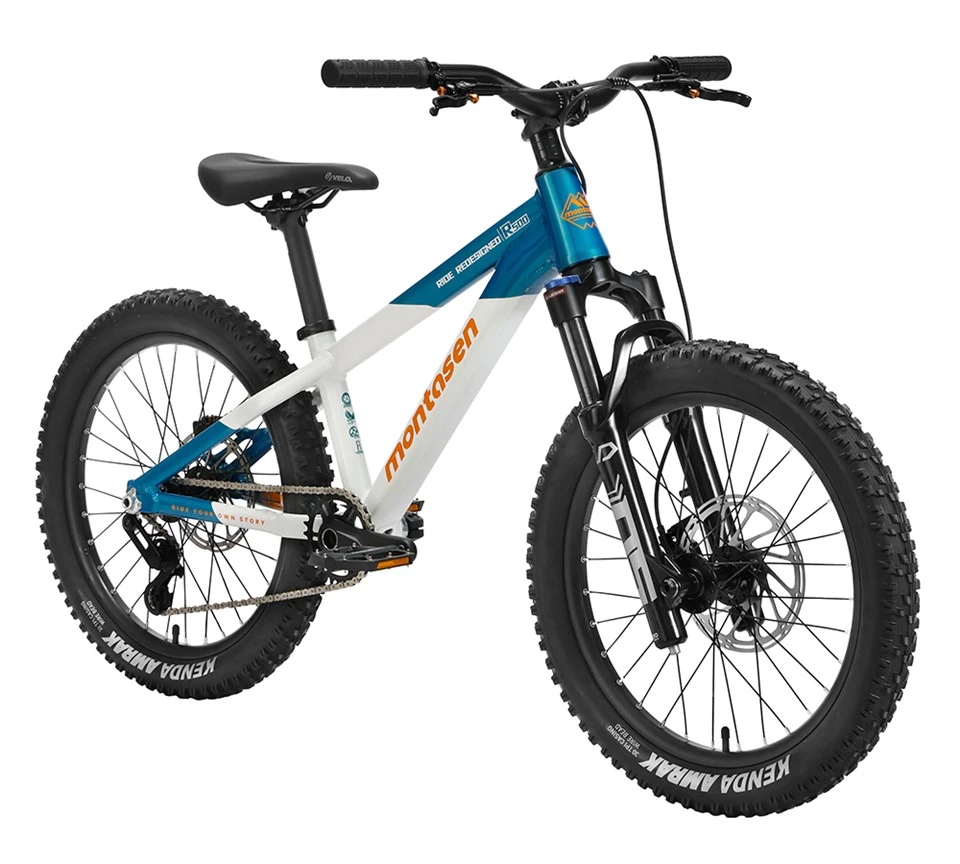
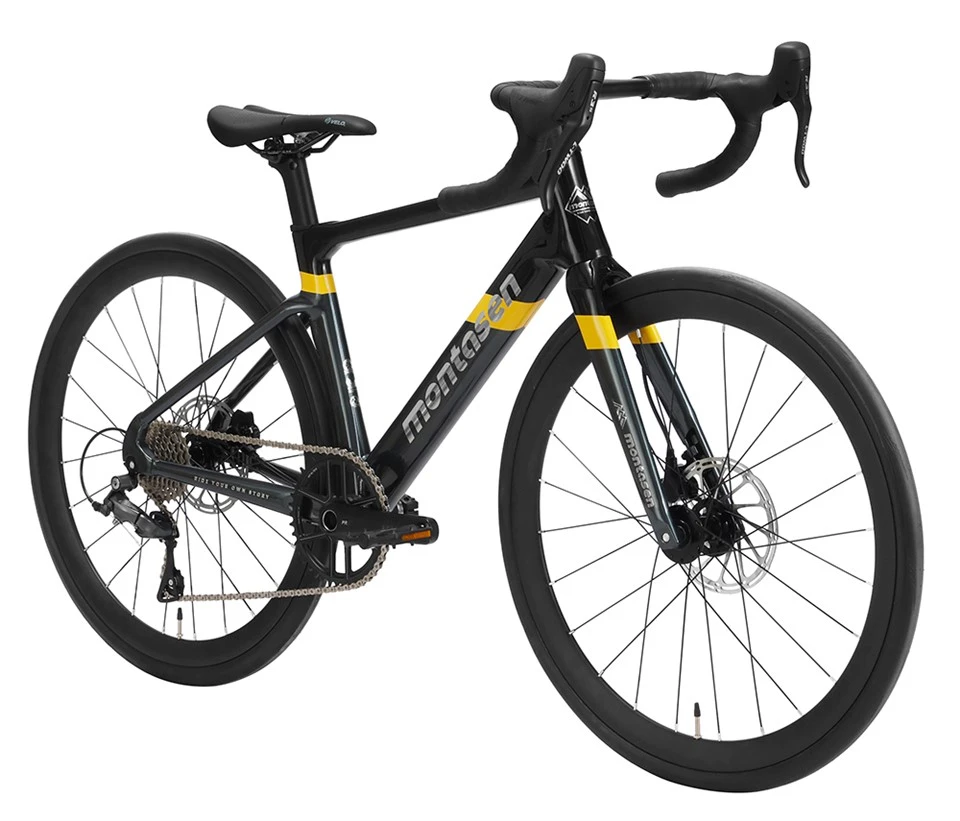
With shorter legs and less strength, children often strain to lift their leg high enough to clear a tall top tube. When stopping, their feet cannot reach the ground, and the bike easily tips over with a slight wobble. Many parents assume this is just because their child is too young and will get the hang of it after a few falls. But from a design perspective, the real issue lies with the bike itself - its frame geometry was never reimagined for children.
The low standover height frame design is Montasen's answer to this very pain point.

1. What Is a Low Standover Height Frame? Let's Start With a Key Figure
The term "low standover height" means the vertical distance between the bike's top tube and the ground is reduced, so children do not need to lift their leg as high to step over the frame.
Take Montasen's R&D practice as an example. The factory's frame production process explicitly lists a step called "ostrich-inspired dropped curved beam welding" technique. The standover height of the D07 balance bike measures only 211mm. This figure means even very young children can easily swing their leg over the frame without straining.
This is not an arbitrary number. Montasen follows a straightforward R&D logic: measure children's body dimensions first, then design the bike's geometry accordingly.
2. Why Is Low Standover Height Especially Critical for Beginner Riders?
2.1 No leg bumps or crotch pinching when mounting and dismounting
Traditional kids' bikes mostly inherit the straight top-tube structure of adult bikes. With short legs and limited strength, children often bump their inner thighs when getting on or off. A low standover frame lowers the top tube, so kids do not need to lift their leg high to mount or dismount, eliminating the risk of impact. This is particularly friendly for girls who wear skirts, as they no longer have to struggle to swing their leg over a high crossbar.
2.2 Feet can quickly plant firmly on the ground during emergency stops
This is the most underrated value of low standover height design.
What children fear most when learning to ride is not being unable to pedal, but being unable to stop. A low standover frame brings the standover point lower, so children can quickly plant both feet on the ground to support the bike during sudden stops, greatly reducing the risk of sideways tipping. For kids who have just removed their training wheels, the sense of security that comes with "being able to touch the ground anytime" directly affects whether they dare to keep riding.
2.3 More natural riding posture, no hunching or shoulder shrugging
Low standover design is usually paired with a high Stack, short Reach frame geometry. Simply put: the handlebars are closer to the body and positioned higher, so children ride with a naturally upright upper body and slightly bent arms. They do not need to lean forward to reach the handlebars, which prevents poor posture such as hunching or shrugging.
2.4 Greater safety in the event of a fall
With a lower frame, the child's center of gravity is also lower when seated. Additionally, Montasen applies rounded edge treatment to the frame and eliminates exposed sharp corners, so the bike is less likely to cause leg injuries if the child falls.

3. A Single Design Backed by a Complete R&D and Production Pipeline
A low standover height frame is not just a tweak to a single part. Its implementation requires support from an entire R&D and manufacturing pipeline.
Inside Montasen's 20,000-square-meter self-owned factory in Fengxian, Shanghai, the frame production workflow is clearly defined: aluminum alloy cutting → ostrich-inspired dropped curved beam welding → weld grinding and edge rounding → spot inspection with standover height gauges. The spot inspection step ensures that every bike coming off the production line meets the design standard for standover height.
As for the inspiration behind this design, Montasen founder Chen Dong put it plainly: "We find design inspiration from negative customer reviews."
At the Fengxian factory, the feedback loop - parent test ride → problem feedback → R&D meeting to break down parameters → workshop prototype revision - can all be completed within a 200-meter physical distance. Many details, such as rounded welds, lower standover points and anti-entanglement chain guards, originated from "kids falling in the test ride area, parents sending videos to customer service, and then those insights turning into blueprints in the workshop."

4. Low Standover Height Is Just the Start: Supporting Safety Details
Montasen's thinking for beginner riders goes far beyond frame height alone. Paired with the low standover design is a complete set of safety logic:
|
Safety Design |
Pain Point Solved |
|
58mm short-reach brake levers for children |
Easy for small hands to squeeze; stops with a light two-finger pull, reliable braking in emergencies |
|
360° fully enclosed chain guard |
Prevents pant cuffs, shoelaces and skirt hems from getting caught; also protects fingers from touching the chain |
|
Rounded frame, hidden screws |
No exposed sharp edges, no skin scratches while riding |
|
Adjustable seat and handlebars with low standover point |
Adjusts with the child's height, ensuring they can always touch the ground |
Take the EB01 Growth Knight as an example. It adopts an arc-shaped dropped low-standover telescopic frame paired with an 8-way adjustment system, fitting children approximately 90–135cm tall. The main frame beam offers 7cm of telescopic adjustment and the seat height has an 11cm adjustment range, so children can find a proper riding posture from age 3 (kindergarten entry) all the way to age 9 (third grade). This is the value of the "low standover + adjustable" combination: the security brought by low standover height remains effective as the child grows.

5. Why Not Just Shrink an Adult Bike?
This is a point Montasen emphasizes repeatedly in R&D: "We don't make shrunken versions of adult bikes. We redesign the geometry based on Chinese children's palm size, crotch height and arm length."
Adults and children have very different body proportions. Simply shrinking an adult frame causes a host of problems: still-excessive standover height, overly long handlebar reach, brake levers unsuitable for small hands, and an overly forward-leaning riding posture. Montasen's approach starts from the real-world use scenarios of beginner riders:
Shorter legs → lower standover height, shorter head tube
Shorter arms → shorter handlebar reach (high Stack, short Reach)
Smaller palms → brake lever reach shortened to 58mm
Less strength → lightweight magnesium alloy / aluminum alloy frame, so the bike is light enough for children to hold up and push
Behind every "lower" and "shorter" is respect for children's physical characteristics.
Frequently Asked Questions (FAQ)
Q1: What age is a low standover height frame suitable for? A: Low standover design mainly serves beginner and younger children, covering the full age range from balance bikes to kids' bicycles.
Q2: Does a low standover frame compromise frame strength? A: No. Montasen uses processes such as one-piece die-casting and fish-scale welding to maintain strength while lowering standover height. The frames have passed 100,000 vibration tests.
Q3: How to tell if a bike's standover height is right for my child? A: Have your child stand over the frame. There should be a 2–3 finger gap between their crotch and the top tube. When seated on the saddle, both feet should rest steadily on the ground (younger children can touch with the balls of their feet). If the crotch is almost touching the frame, the standover height is too high.
Q4: What special benefits does a low standover frame have for girls? A: The most direct benefit is safer mounting and dismounting when wearing skirts. The low standover design eliminates the need to lift the leg high over a crossbar. Combined with a fully enclosed chain guard, it effectively prevents skirt hems from getting caught and reduces the risk of bumps when getting on and off.
Q5: Is the low standover height frame patented by Montasen? A: Low standover geometry is one of the core designs across Montasen's entire product line. Combined with its portfolio of over 160 proprietary patents (including the 8-way adjustable telescopic frame), it forms the company's technical expertise in child-specific frame geometry.
Closing Thoughts
A low standover height frame may seem like a simple adjustment to "height," but behind it lies Montasen's complete re-understanding of beginner riders: children have short legs, so the standover point must be low; children have less strength, so the bike must be light; children have small hands, so brake lever reach must be shortened; children wear skirts, so there must be no risk of pinching or jamming during mounting and dismounting.
These seemingly small improvements are exactly what the founder calls "the basic skills of a bike builder" - turning every pain point into a design highlight. Low standover height is just the starting point of Montasen's child-centered frame geometry design.