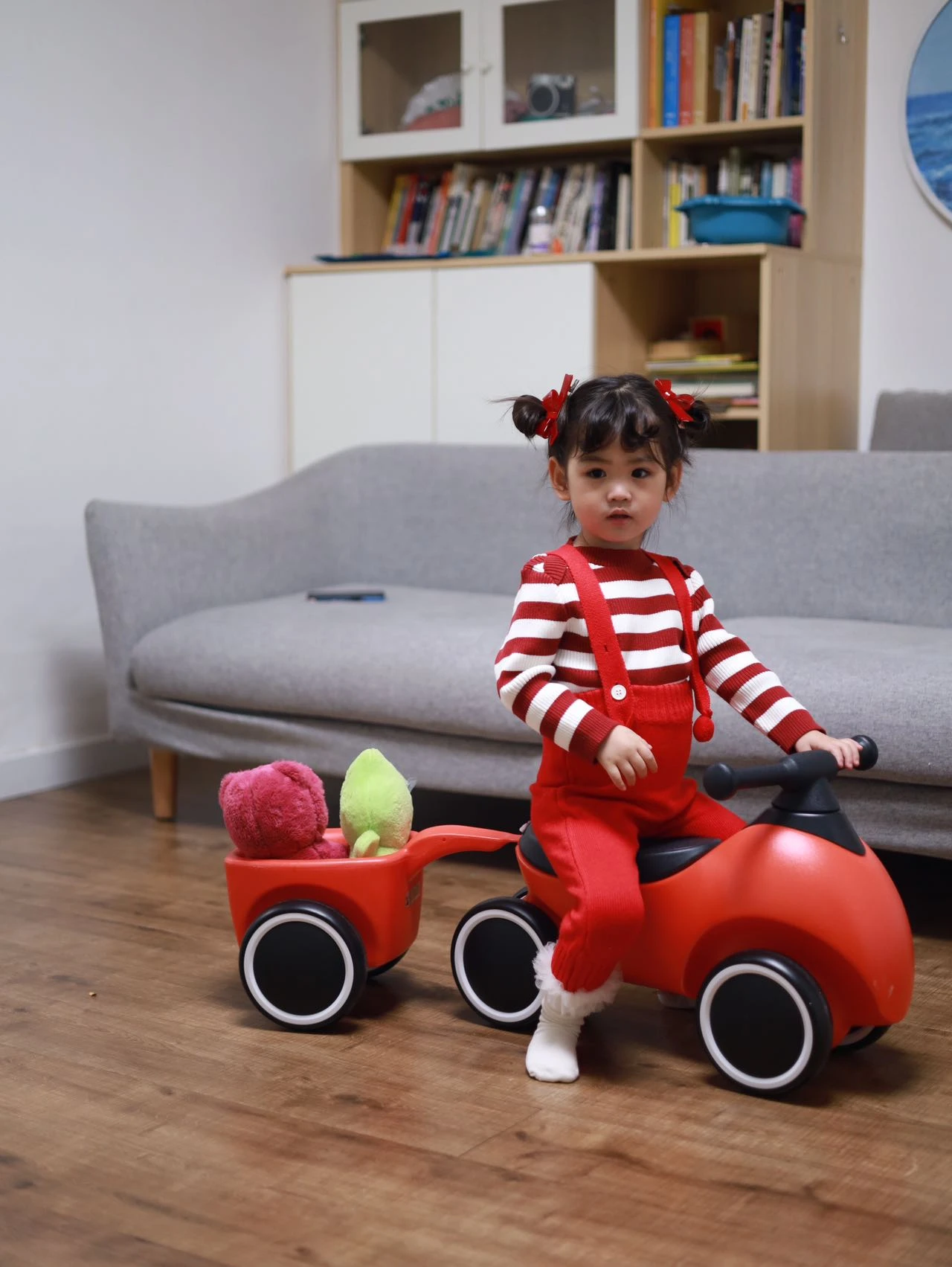
Every category has a product that looks simple and quietly explains the whole market. In the toddler ride-on segment, that product is the Montasen MINI01 - a six-inch, four-wheel plastic ride-on with a detachable trailer, built for children roughly 18 to 36 months old and 75–95 cm tall. On a shelf it reads as a toy. Taken apart, it reads as an engineering brief: the entire design language of Plastic ride-on toys - stability geometry, material safety, wheel architecture, modularity - compressed into 3.4 kg of molded plastic.
**The category's real job is not transportation**
Plastic ride-on toys sit at the intersection of three purchase motives: a first "vehicle" for a child who cannot yet pedal, a screen-free outlet for indoor energy, and a piece of furniture parents are willing to keep in the living room. That combination sets the constraints. The product must be stable enough to be safe for a beginner, quiet enough for an apartment, light enough for one adult to carry up stairs, and durable enough to survive a second child.
The MINI01 answers each constraint with a specific engineering decision rather than styling.
**Constraint one: stability**
Toddlers tip over sideways, not forward. The MINI01 addresses this with a four-wheel layout deliberately arranged with the rear track narrower than the front, a 15 cm wheel track, and a steering angle mechanically limited to about 20 degrees. That limit is the single most important safety decision in the product: it makes sharp, tip-inducing turns physically impossible, which matters because a two-year-old's steering input is impulsive, not predictive. The seat sits 26 cm off the ground and the handlebar 39 cm, keeping the center of gravity low - and the vehicle intentionally carries real mass (3.4 kg bare, 3.8 kg with trailer) rather than chasing lightness, because an under-weighted ride-on is easier to flip and harder to control.
**Constraint two: materials and certification**
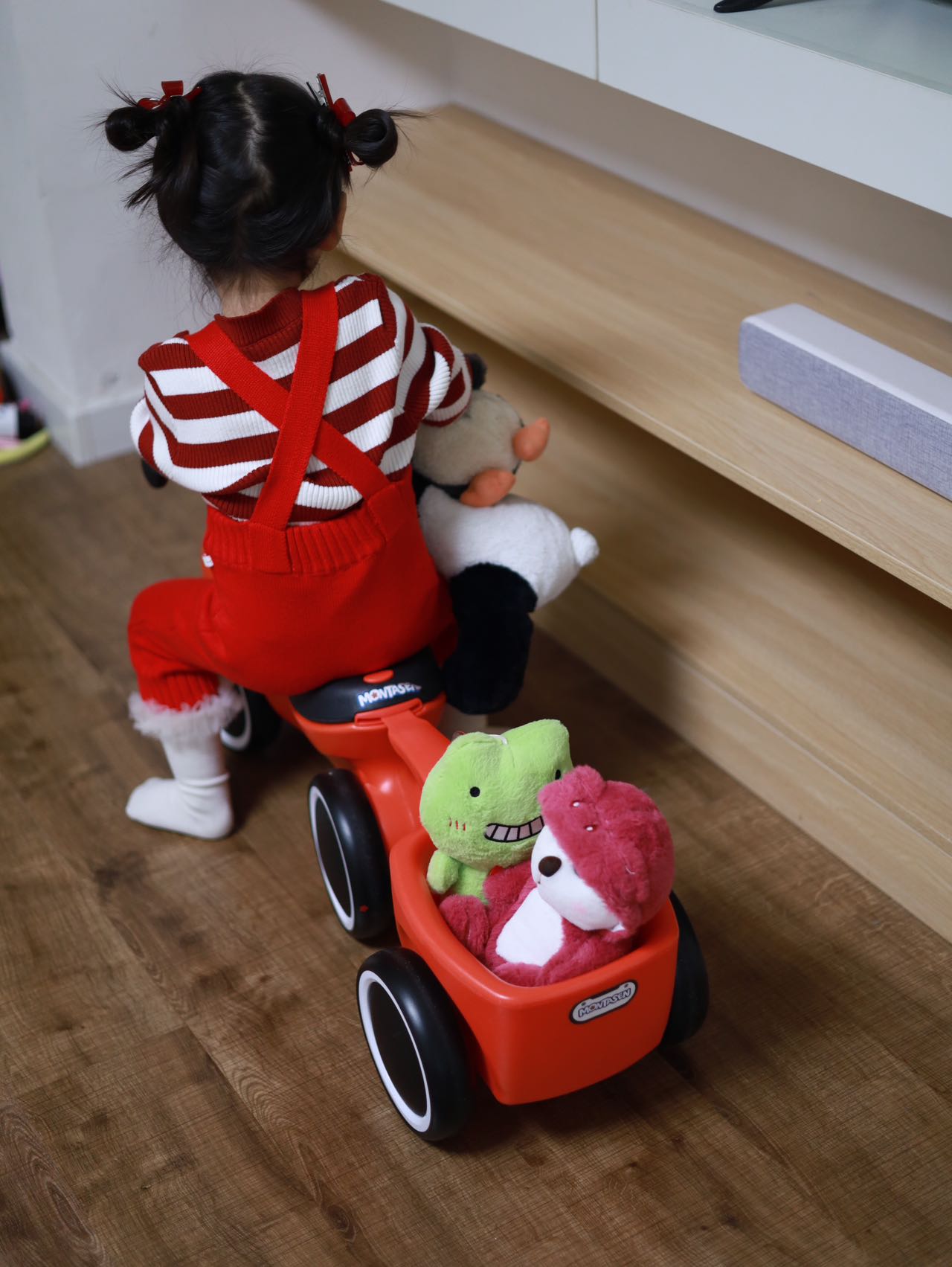
The body is one-piece blow-molded PE - biodegradable-class polyolefin, seamless, with no burrs or sharp edges at any junction, since there are no junctions to speak of. This is a meaningful shift from the older injection-molded, multi-part construction still common in the category: fewer seams mean fewer failure points, no screw bosses to work loose, and no edges for a crawling sibling to catch a finger on. The steering handlebar is a single die-cast piece for the same logic - one part, one grip surface, nothing to disassemble.
Compliance is the entry ticket, not the differentiator. Products in this segment must clear GB 6675 toy safety requirements and China's 3C compulsory certification, and export lines must satisfy EN 71 and ASTM F963. The MINI01 carries 3C certification and two design patents covering its body and trailer configuration - the patents matter commercially, because in a category where shapes are easy to copy, industrial design registration is the practical moat.
**Constraint three: wheels**
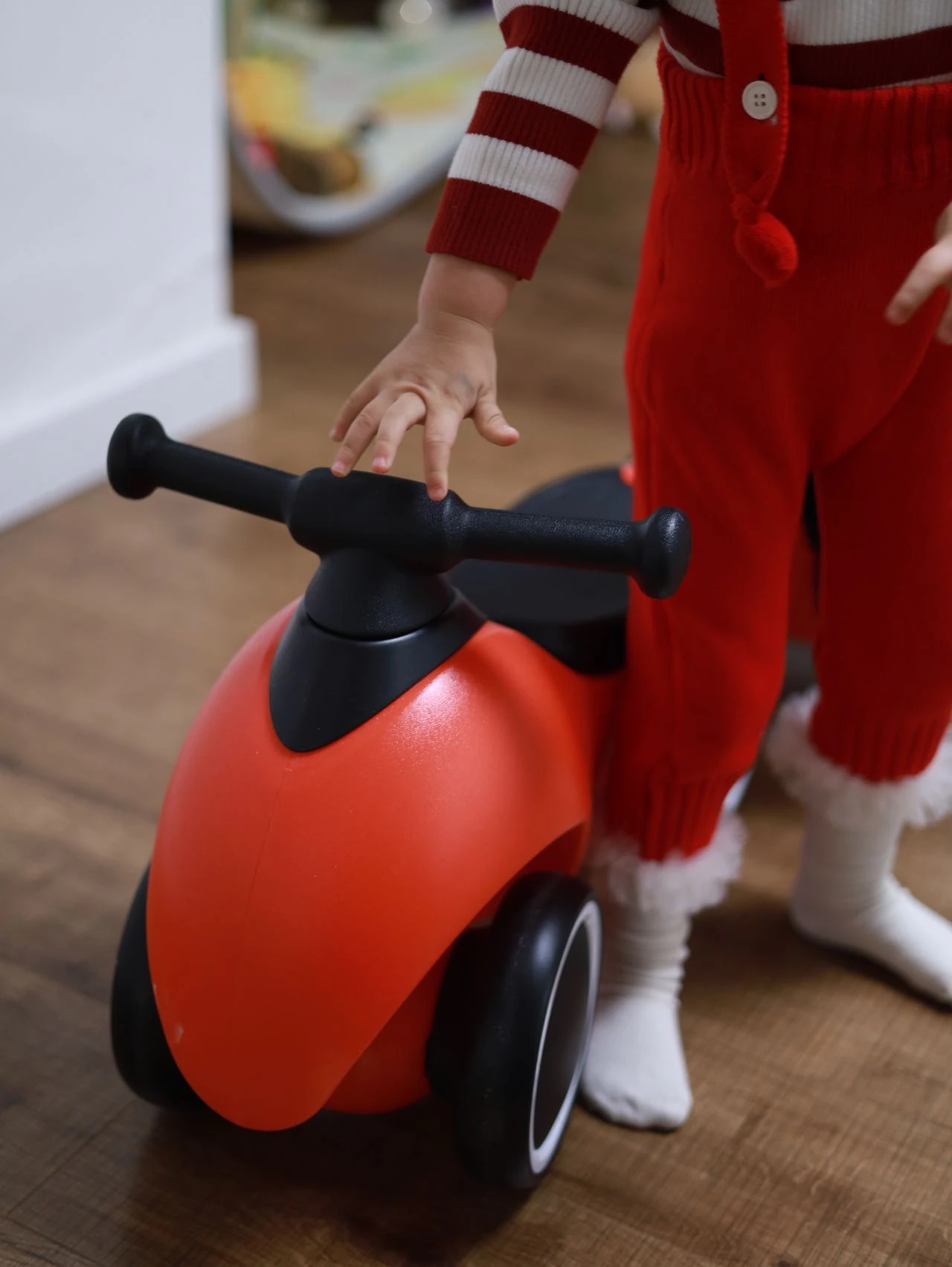
Fully enclosed EVA wheels are the most underrated specification on the sheet. Three properties come bundled: no spokes or gaps where small fingers can be pinched; near-silent rolling, which is what makes the product usable on hardwood and tile indoors; and no inflation, no punctures, no maintenance. The trade-off is honest - EVA is quieter and safer but gives up some grip on gravel and wet grass compared with treaded rubber. For a product positioned for indoor-first, apartment-first use in the 18–36 month window, that is the correct trade.
**Constraint four: ergonomics**Plastic ride-on toys
The seat is shaped to a 14 × 27 cm platform that fits a toddler's pelvis rather than a scaled-down adult silhouette, and the one-piece handlebar is sized to a child's grip span. Both sound like detail; both decide whether a child rides for four minutes or forty. Ride-on design has broadly moved from "shrunken car" aesthetics to posture-first geometry, and the MINI01 sits firmly on the newer side of that line.
**Constraint five: modularity - the industry's quiet growth engine**
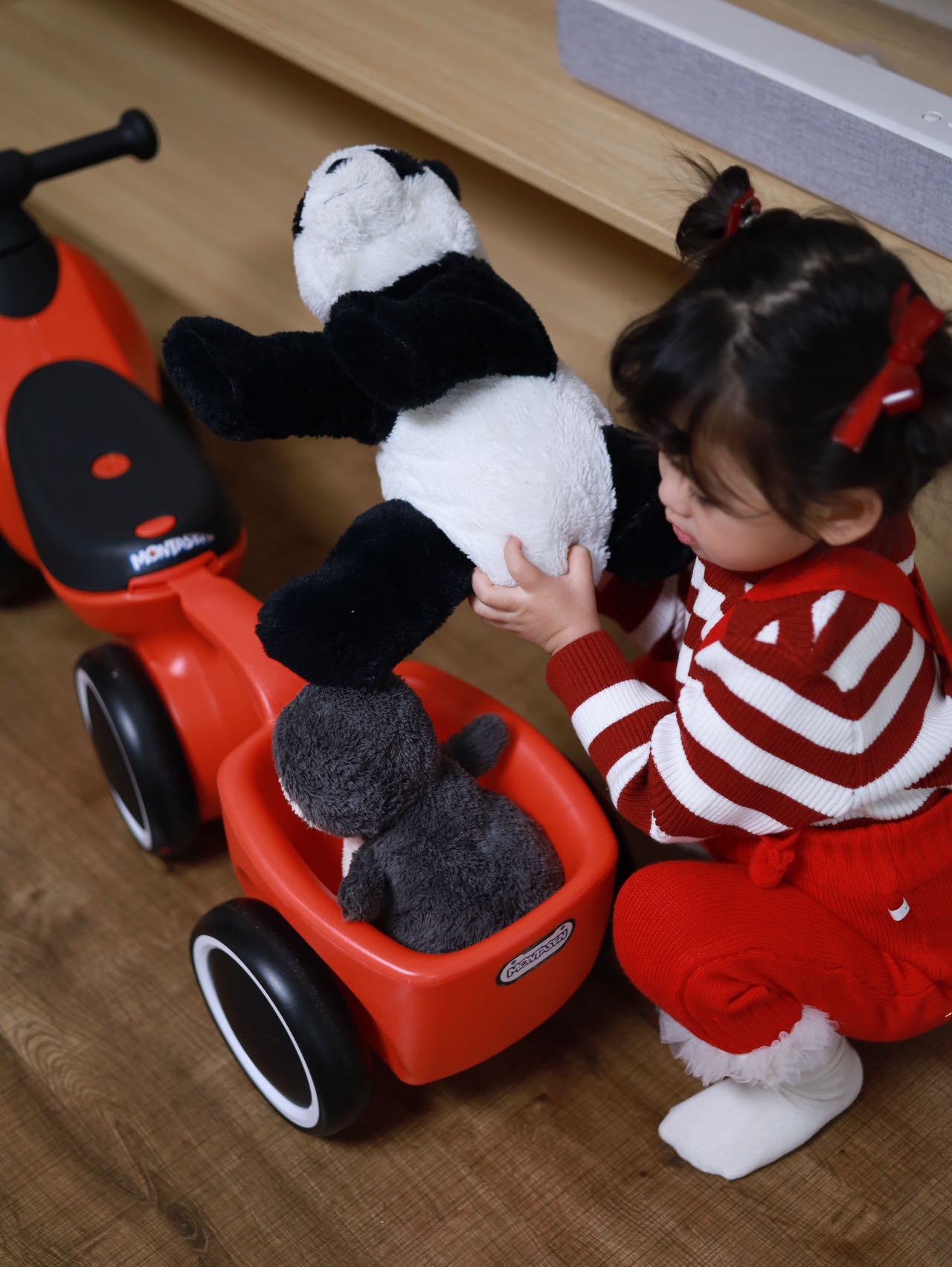
The detachable 4L trailer is the commercial centerpiece. It releases without tools via a single button-and-pull action, converting the product between a solo ride-on and a combined unit in seconds. This is the pattern the whole category is converging on: one platform, multiple configurations, extended relevance. Practically, the trailer does three jobs at once - it hauls toys, it seats a second small child, and it gives the product a second life stage as a pull-along. For brands, modularity also reduces SKU count, since one chassis covers several retail stories; the 61 × 31 × 43 cm carton and 4.6 kg gross weight are shippable and storable without special handling.
**What the product says about where the category is going**
Three industry readings are worth taking from a product this small.
First, **the ride-on is being re-specified as a developmental tool.** The marketing language has shifted from "fun car" to gross-motor development, balance, and steering control - and the engineering has followed, with steering limiters, low center of gravity, and posture-shaped seating now standard expectations rather than premium features.
Second, **safety is increasingly designed into geometry rather than added as accessories.** A 20-degree steering cap prevents a failure mode; a padded seat belt does not. Buyers, especially in export markets, are learning to ask which one they are getting.
Third, **channel diversification defines the winners.** The MINI01 appears across mainstream e-commerce platforms, brand DTC, and non-retail gift and loyalty catalogs - a reminder that in the sub-$50 toddler segment, distribution breadth often decides volume more than incremental feature gains, and gift-season timing matters as much as product quality.
Strip away the styling and the MINI01 is a compact statement of the category's maturity: a limited-steering, low-center-of-gravity chassis; a seamless, certified, single-piece body; silent enclosed wheels; and a tool-free modular trailer. None of it is glamorous. All of it is what separates a toy that survives two children and four years from one that survives a season.**he Smallest Chassis, the Biggest Lesson: What the Plastic ride-on toys Reveals About the Toddler Ride-On Category**
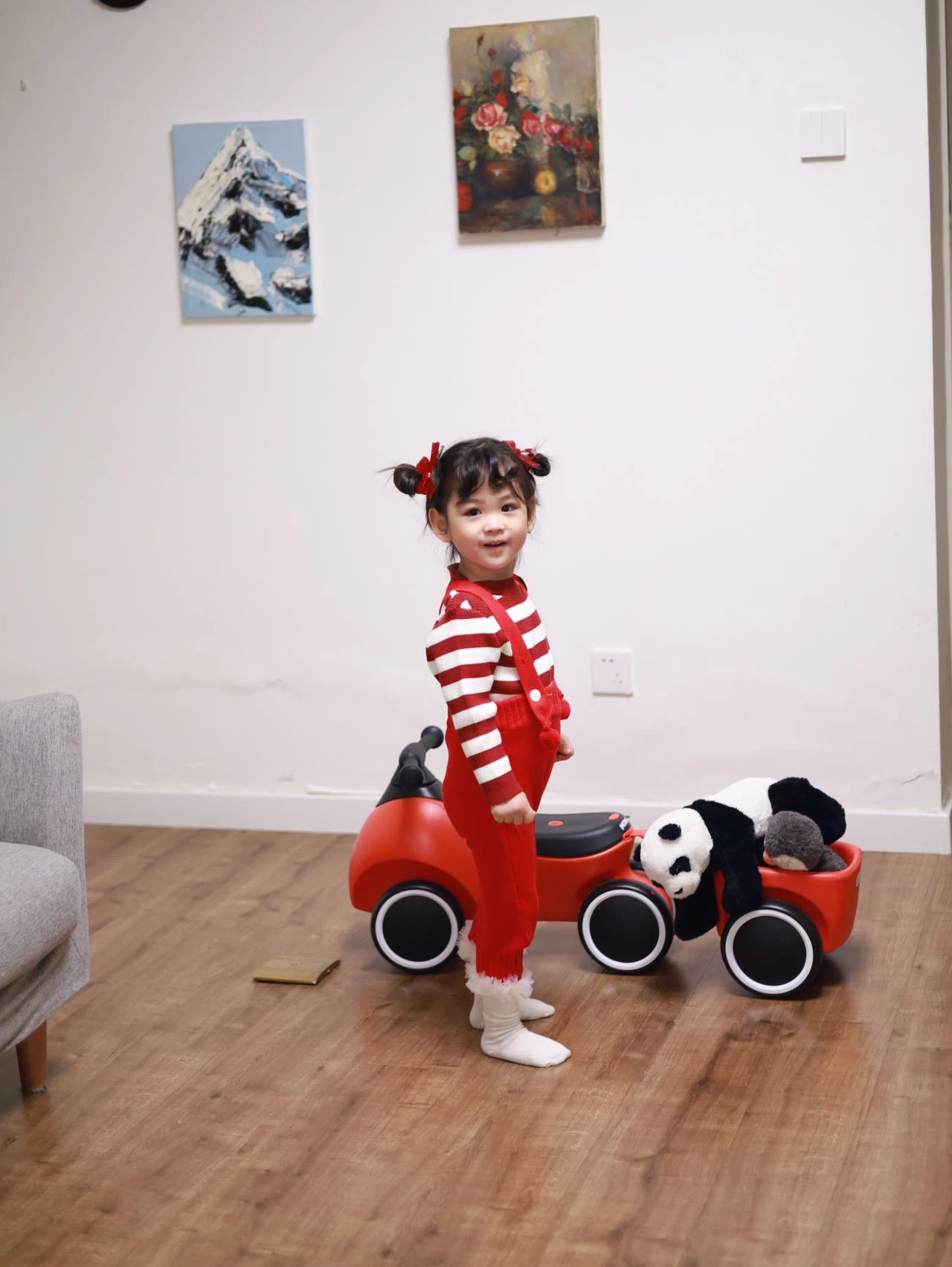
Every category has a product that looks simple and quietly explains the whole market. In the toddler ride-on segment, that product is the Montasen MINI01 - a six-inch, four-wheel plastic ride-on with a detachable trailer, built for children roughly 18 to 36 months old and 75–95 cm tall. On a shelf it reads as a toy. Taken apart, it reads as an engineering brief: the entire design language of modern ride-on development - stability geometry, material safety, wheel architecture, modularity - compressed into 3.4 kg of molded plastic.
**The category's real job is not transportation**
Ride-ons sit at the intersection of three purchase motives: a first "vehicle" for a child who cannot yet pedal, a screen-free outlet for indoor energy, and a piece of furniture parents are willing to keep in the living room. That combination sets the constraints. The product must be stable enough to be safe for a beginner, quiet enough for an apartment, light enough for one adult to carry up stairs, and durable enough to survive a second child.
The MINI01 answers each constraint with a specific engineering decision rather than styling.
**Constraint one: stability**Plastic ride-on toys
Toddlers tip over sideways, not forward. The MINI01 addresses this with a four-wheel layout deliberately arranged with the rear track narrower than the front, a 15 cm wheel track, and a steering angle mechanically limited to about 20 degrees. That limit is the single most important safety decision in the product: it makes sharp, tip-inducing turns physically impossible, which matters because a two-year-old's steering input is impulsive, not predictive. The seat sits 26 cm off the ground and the handlebar 39 cm, keeping the center of gravity low - and the vehicle intentionally carries real mass (3.4 kg bare, 3.8 kg with trailer) rather than chasing lightness, because an under-weighted ride-on is easier to flip and harder to control.
**Constraint two: materials and certification**
The body is one-piece blow-molded PE - biodegradable-class polyolefin, seamless, with no burrs or sharp edges at any junction, since there are no junctions to speak of. This is a meaningful shift from the older injection-molded, multi-part construction still common in the category: fewer seams mean fewer failure points, no screw bosses to work loose, and no edges for a crawling sibling to catch a finger on. The steering handlebar is a single die-cast piece for the same logic - one part, one grip surface, nothing to disassemble.
Compliance is the entry ticket, not the differentiator. Products in this segment must clear GB 6675 toy safety requirements and China's 3C compulsory certification, and export lines must satisfy EN 71 and ASTM F963. The MINI01 carries 3C certification and two design patents covering its body and trailer configuration - the patents matter commercially, because in a category where shapes are easy to copy, industrial design registration is the practical moat.
**Constraint three: wheels**Plastic ride-on toys
Fully enclosed EVA wheels are the most underrated specification on the sheet. Three properties come bundled: no spokes or gaps where small fingers can be pinched; near-silent rolling, which is what makes the product usable on hardwood and tile indoors; and no inflation, no punctures, no maintenance. The trade-off is honest - EVA is quieter and safer but gives up some grip on gravel and wet grass compared with treaded rubber. For a product positioned for indoor-first, apartment-first use in the 18–36 month window, that is the correct trade.
**Constraint four: ergonomics**
The seat is shaped to a 14 × 27 cm platform that fits a toddler's pelvis rather than a scaled-down adult silhouette, and the one-piece handlebar is sized to a child's grip span. Both sound like detail; both decide whether a child rides for four minutes or forty. Ride-on design has broadly moved from "shrunken car" aesthetics to posture-first geometry, and the MINI01 sits firmly on the newer side of that line.
**Constraint five: modularity - the industry's quiet growth engine**
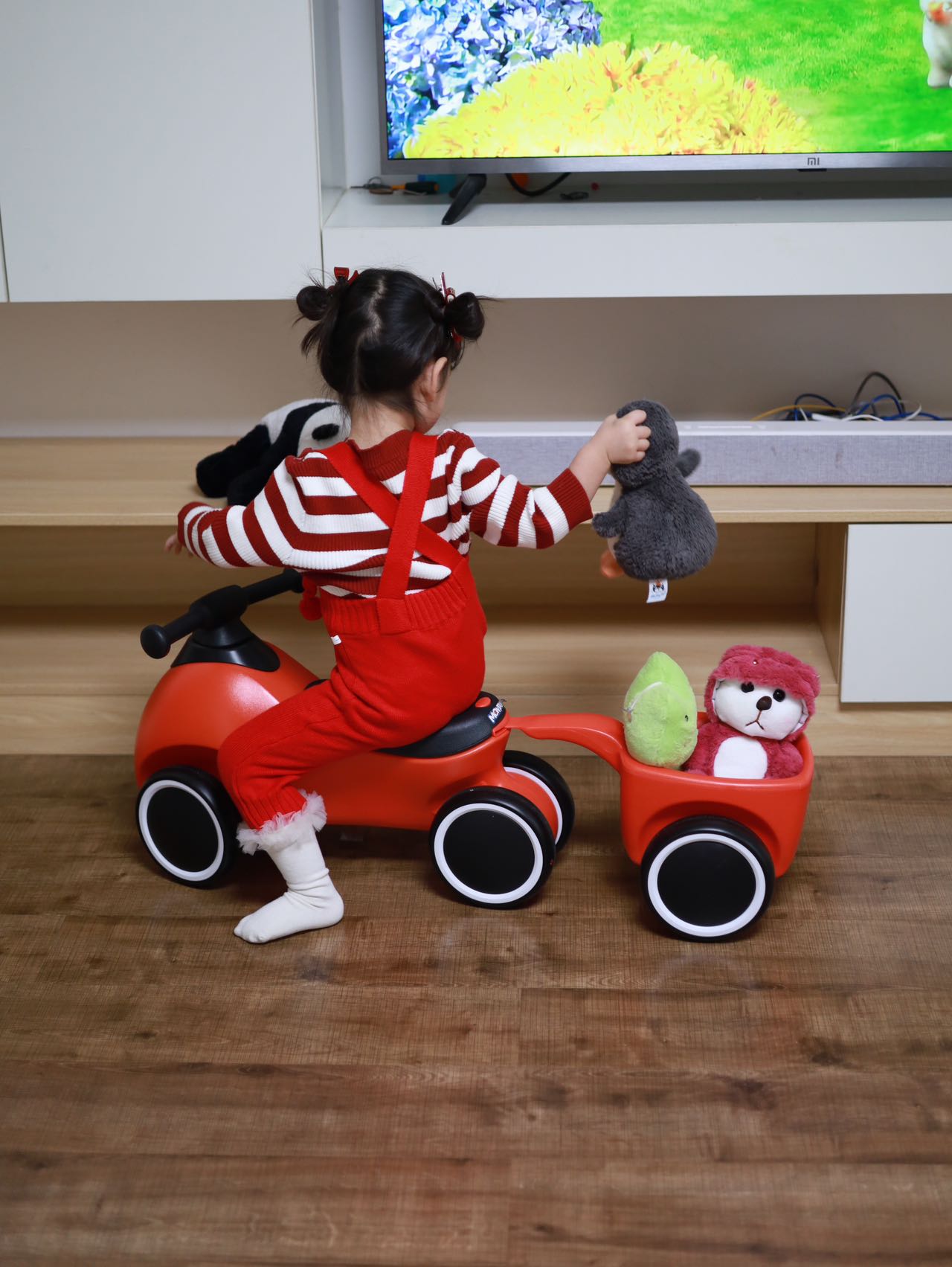
The detachable 4L trailer is the commercial centerpiece. It releases without tools via a single button-and-pull action, converting the product between a solo ride-on and a combined unit in seconds. This is the pattern the whole category is converging on: one platform, multiple configurations, extended relevance. Practically, the trailer does three jobs at once - it hauls toys, it seats a second small child, and it gives the product a second life stage as a pull-along. For brands, modularity also reduces SKU count, since one chassis covers several retail stories; the 61 × 31 × 43 cm carton and 4.6 kg gross weight are shippable and storable without special handling.
**What the product says about where the category is going**
Three industry readings are worth taking from a product this small.
First, **the ride-on is being re-specified as a developmental tool.** The marketing language has shifted from "fun car" to gross-motor development, balance, and steering control - and the engineering has followed, with steering limiters, low center of gravity, and posture-shaped seating now standard expectations rather than premium features.
Second, **safety is increasingly designed into geometry rather than added as accessories.** A 20-degree steering cap prevents a failure mode; a padded seat belt does not. Buyers, especially in export markets, are learning to ask which one they are getting.
Third, **channel diversification defines the winners.** The MINI01 appears across mainstream e-commerce platforms, brand DTC, and non-retail gift and loyalty catalogs - a reminder that in the sub-$50 toddler segment, distribution breadth often decides volume more than incremental feature gains, and gift-season timing matters as much as product quality.